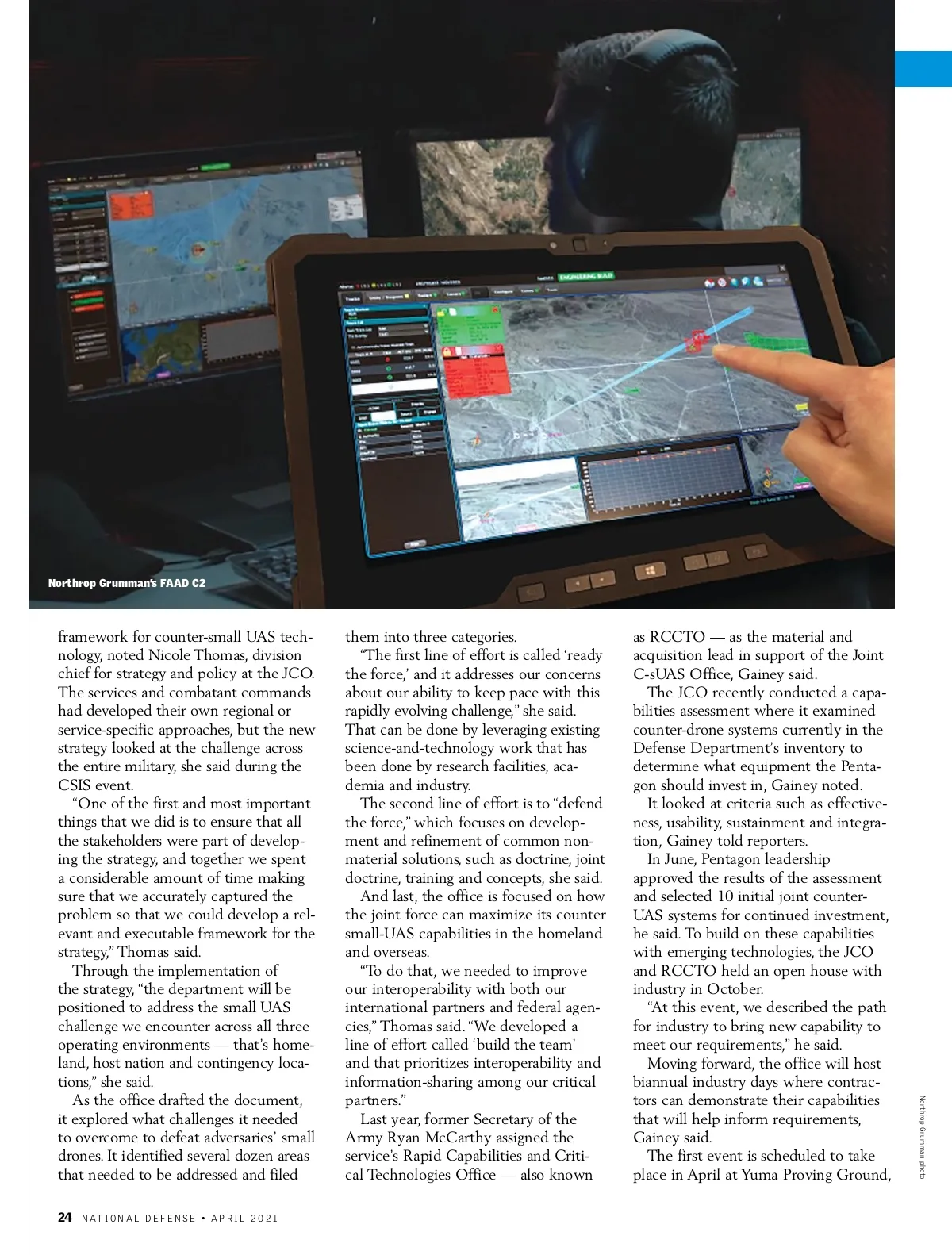
Northrop Grumman’s FAAD C2 framework for counter-small UAS tech-nology, noted Nicole Thomas, division chief for strategy and policy at the JCO. The services and combatant commands had developed their own regional or service-specific approaches, but the new strategy looked at the challenge across the entire military, she said during the CSIS event. “One of the first and most important things that we did is to ensure that all the stakeholders were part of develop-ing the strategy, and together we spent a considerable amount of time making sure that we accurately captured the problem so that we could develop a rel-evant and executable framework for the strategy,” Thomas said. Through the implementation of the strategy, “the department will be positioned to address the small UAS challenge we encounter across all three operating environments — that’s home-land, host nation and contingency loca-tions,” she said. As the office drafted the document, it explored what challenges it needed to overcome to defeat adversaries’ small drones. It identified several dozen areas that needed to be addressed and filed 24 N AT I O N A L D E F E N S E • A P R I L 2 0 2 1 them into three categories. “The first line of effort is called ‘ready the force,’ and it addresses our concerns about our ability to keep pace with this rapidly evolving challenge,” she said. That can be done by leveraging existing science-and-technology work that has been done by research facilities, aca-demia and industry. The second line of effort is to “defend the force,” which focuses on develop-ment and refinement of common non-material solutions, such as doctrine, joint doctrine, training and concepts, she said. And last, the office is focused on how the joint force can maximize its counter small-UAS capabilities in the homeland and overseas. “To do that, we needed to improve our interoperability with both our international partners and federal agen-cies,” Thomas said. “We developed a line of effort called ‘build the team’ and that prioritizes interoperability and information-sharing among our critical partners.” Last year, former Secretary of the Army Ryan McCarthy assigned the service’s Rapid Capabilities and Criti-cal Technologies Office — also known as RCCTO — as the material and acquisition lead in support of the Joint C-sUAS Office, Gainey said. The JCO recently conducted a capa-bilities assessment where it examined counter-drone systems currently in the Defense Department’s inventory to determine what equipment the Penta-gon should invest in, Gainey noted. It looked at criteria such as effective-ness, usability, sustainment and integra-tion, Gainey told reporters. In June, Pentagon leadership approved the results of the assessment and selected 10 initial joint counter-UAS systems for continued investment, he said. To build on these capabilities with emerging technologies, the JCO and RCCTO held an open house with industry in October. “At this event, we described the path for industry to bring new capability to meet our requirements,” he said. Moving forward, the office will host biannual industry days where contrac-tors can demonstrate their capabilities that will help inform requirements, Gainey said. The first event is scheduled to take place in April at Yuma Proving Ground, Northrop Grumman photo
National Defense Digital April 2021: Page-24