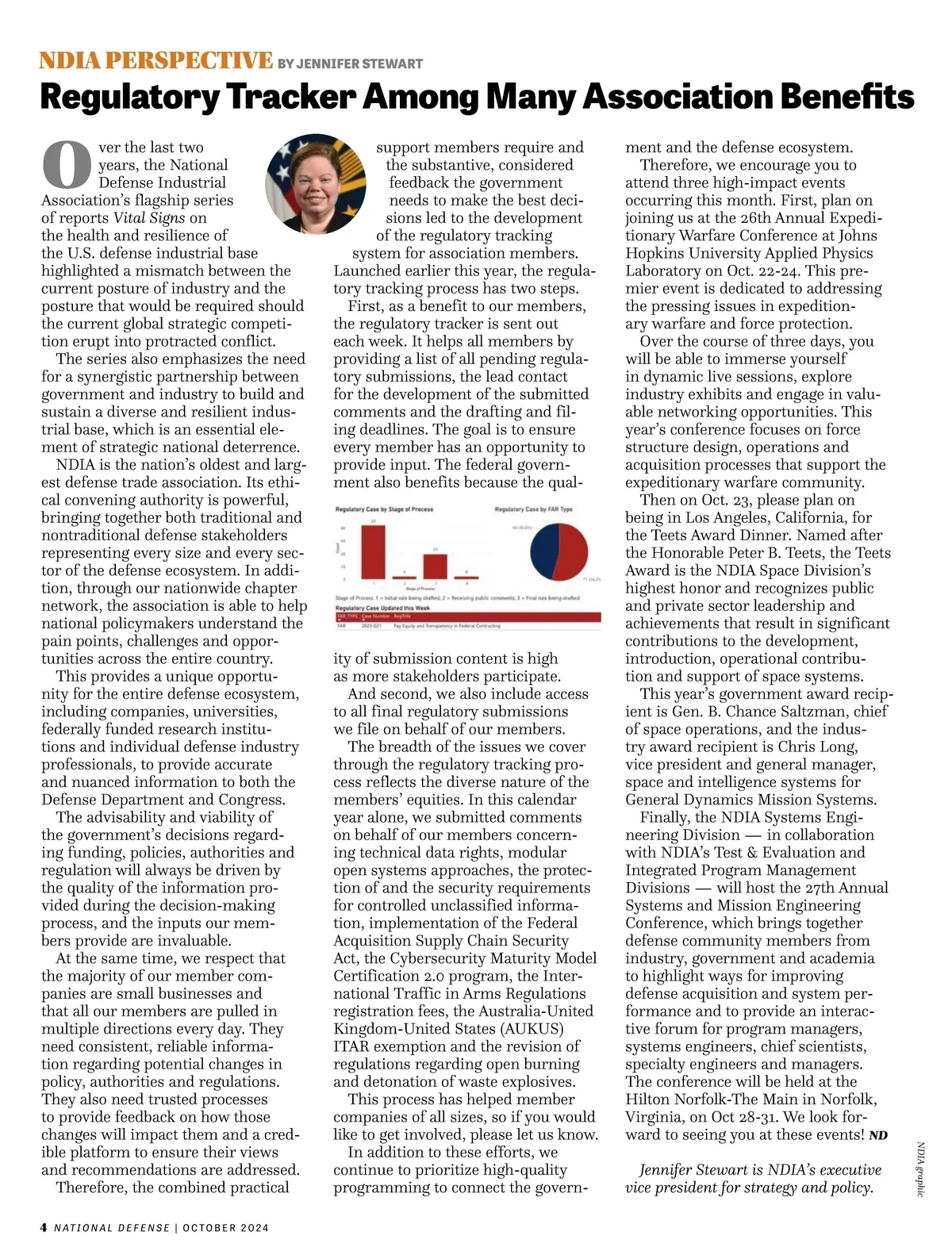
NDIA PERSPECTIVE BY JENNIFER STEWART Regulatory Tracker Among Many Association Benefits O ver the last two years, the National Defense Industrial Association’s flagship series of reports Vital Signs on the health and resilience of the U.S. defense industrial base highlighted a mismatch between the current posture of industry and the posture that would be required should the current global strategic competi-tion erupt into protracted conflict. The series also emphasizes the need for a synergistic partnership between government and industry to build and sustain a diverse and resilient indus-trial base, which is an essential ele-ment of strategic national deterrence. NDIA is the nation’s oldest and larg-est defense trade association. Its ethi-cal convening authority is powerful, bringing together both traditional and nontraditional defense stakeholders representing every size and every sec-tor of the defense ecosystem. In addi-tion, through our nationwide chapter network, the association is able to help national policymakers understand the pain points, challenges and oppor-tunities across the entire country. This provides a unique opportu-nity for the entire defense ecosystem, including companies, universities, federally funded research institu-tions and individual defense industry professionals, to provide accurate and nuanced information to both the Defense Department and Congress. The advisability and viability of the government’s decisions regard-ing funding, policies, authorities and regulation will always be driven by the quality of the information pro-vided during the decision-making process, and the inputs our mem-bers provide are invaluable. At the same time, we respect that the majority of our member com-panies are small businesses and that all our members are pulled in multiple directions every day. They need consistent, reliable informa-tion regarding potential changes in policy, authorities and regulations. They also need trusted processes to provide feedback on how those changes will impact them and a cred-ible platform to ensure their views and recommendations are addressed. Therefore, the combined practical NATIONAL DEFENSE | OCTOBER 2024 support members require and the substantive, considered feedback the government needs to make the best deci-sions led to the development of the regulatory tracking system for association members. Launched earlier this year, the regula-tory tracking process has two steps. First, as a benefit to our members, the regulatory tracker is sent out each week. It helps all members by providing a list of all pending regula-tory submissions, the lead contact for the development of the submitted comments and the drafting and fil-ing deadlines. The goal is to ensure every member has an opportunity to provide input. The federal govern-ment also benefits because the qual-ity of submission content is high as more stakeholders participate. And second, we also include access to all final regulatory submissions we file on behalf of our members. The breadth of the issues we cover through the regulatory tracking pro-cess reflects the diverse nature of the members’ equities. In this calendar year alone, we submitted comments on behalf of our members concern-ing technical data rights, modular open systems approaches, the protec-tion of and the security requirements for controlled unclassified informa-tion, implementation of the Federal Acquisition Supply Chain Security Act, the Cybersecurity Maturity Model Certification 2.0 program, the Inter-national Traffic in Arms Regulations registration fees, the Australia-United Kingdom-United States (AUKUS) ITAR exemption and the revision of regulations regarding open burning and detonation of waste explosives. This process has helped member companies of all sizes, so if you would like to get involved, please let us know. In addition to these efforts, we continue to prioritize high-quality programming to connect the govern-ment and the defense ecosystem. Therefore, we encourage you to attend three high-impact events occurring this month. First, plan on joining us at the 26th Annual Expedi-tionary Warfare Conference at Johns Hopkins University Applied Physics Laboratory on Oct. 22-24. This pre-mier event is dedicated to addressing the pressing issues in expedition-ary warfare and force protection. Over the course of three days, you will be able to immerse yourself in dynamic live sessions, explore industry exhibits and engage in valu-able networking opportunities. This year’s conference focuses on force structure design, operations and acquisition processes that support the expeditionary warfare community. Then on Oct. 23, please plan on being in Los Angeles, California, for the Teets Award Dinner. Named after the Honorable Peter B. Teets, the Teets Award is the NDIA Space Division’s highest honor and recognizes public and private sector leadership and achievements that result in significant contributions to the development, introduction, operational contribu-tion and support of space systems. This year’s government award recip-ient is Gen. B. Chance Saltzman, chief of space operations, and the indus-try award recipient is Chris Long, vice president and general manager, space and intelligence systems for General Dynamics Mission Systems. Finally, the NDIA Systems Engi-neering Division — in collaboration with NDIA’s Test & Evaluation and Integrated Program Management Divisions — will host the 27th Annual Systems and Mission Engineering Conference, which brings together defense community members from industry, government and academia to highlight ways for improving defense acquisition and system per-formance and to provide an interac-tive forum for program managers, systems engineers, chief scientists, specialty engineers and managers. The conference will be held at the Hilton Norfolk-The Main in Norfolk, Virginia, on Oct 28-31. We look for-ward to seeing you at these events! ND Jennifer Stewart is NDIA’s executive vice president for strategy and policy. NDIA graphic 4
National Defense Digital October 2024: Page-4